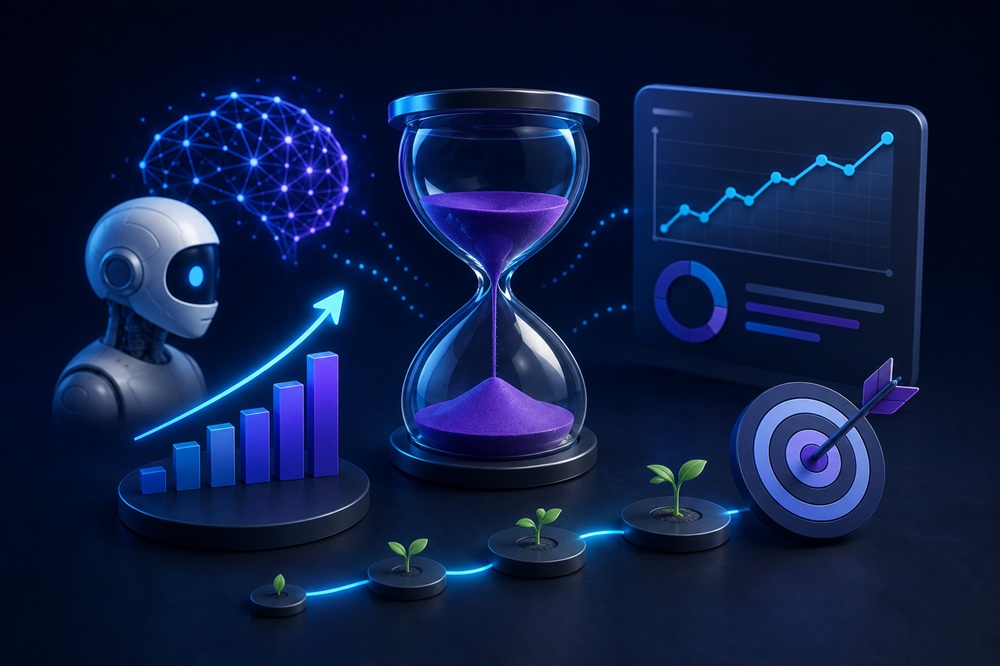
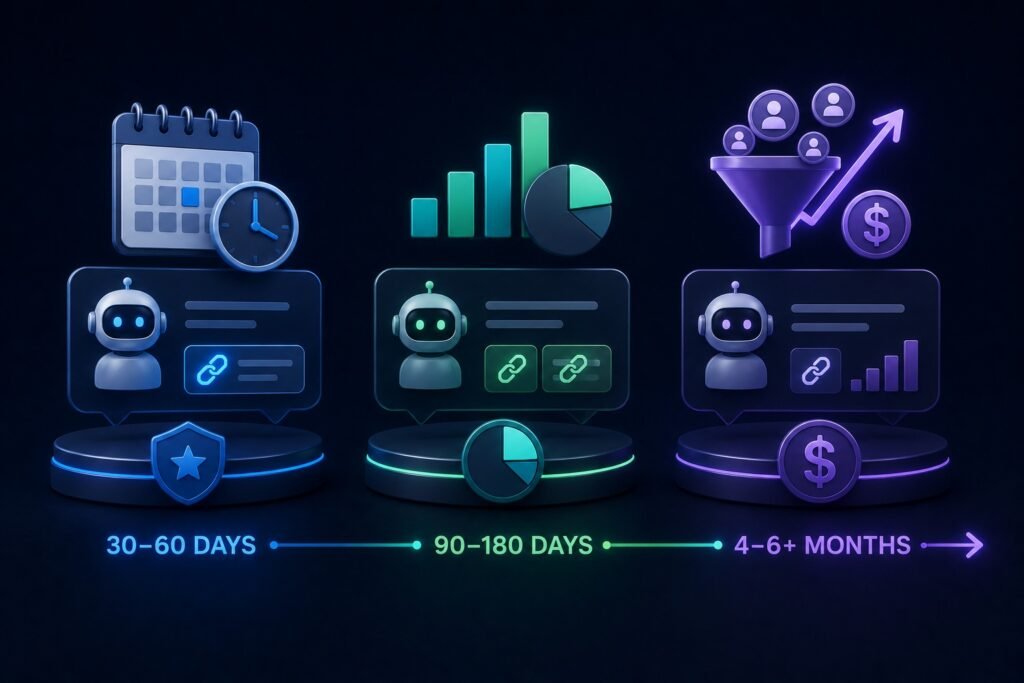
One of the first questions B2B leaders ask when considering AI Engine Optimization: how long until we see results? The answer depends on what “results” means, but AEO produces measurable signal faster than SEO traditionally has — usually within 30 to 60 days for first citations, and 90 to 180 days for material citation share across all four major AI engines.
What “results” actually means in AEO
AEO results are measured across three layers, each with its own timeline.
Citation appearance — the first time your business is named or linked in an AI engine’s answer to a relevant query. This is the fastest result, typically appearing within 30 to 60 days of schema deployment, content restructuring, and llms.txt publication.
Citation share — the percentage of relevant queries across AI engines where your business is cited. This builds more slowly. Material share (where you’re cited consistently for a meaningful portion of your target query space) typically develops over 90 to 180 days.
Pipeline contribution — measurable inbound interest attributable to AI citations. This is the slowest and hardest to measure but the most important. Most B2B teams begin seeing pipeline signal at 4 to 6 months, scaling through month 12 and beyond as topical authority compounds.
AI engines re-crawl and re-index more frequently than Google traditionally has, so technical changes (schema, content, llms.txt) take effect faster. But authority signals — E-E-A-T, citation chains, topical depth — take the same time to build for AI engines as they do for traditional search.
Common questions
How long does AI Engine Optimization take to show results?
There is no fixed timeline. AI Engine Optimization (AEO/GEO) results can appear within weeks for some pages, while broader visibility improvements may take several months. The timeline depends on the website’s existing authority, technical accessibility, content quality, topical coverage, competition, and how frequently AI systems discover and reassess the site’s content.
Can AI citations increase within a few weeks?
Yes, particularly when the problem is technical or the website already has strong authority. Fixing crawlability problems, improving poorly structured pages, answering specific questions clearly, or strengthening existing content can sometimes produce relatively quick changes. However, short-term fluctuations should not be treated as proof of a lasting improvement because AI responses can vary from one query or date to another.
How long should you test an AI optimization strategy before judging it?
A practical initial evaluation period is around
2–3 months. Track a consistent set of prompts throughout that period rather than comparing random AI searches. For a broader content program involving new pages, topical authority, original research, and significant site improvements,
3–6 months or longer may provide a more meaningful assessment.
What factors affect how quickly AI visibility improves?
Important factors include:
- Website crawlability and accessibility
- Existing search visibility and authority
- Quality and originality of content
- Topical depth and content coverage
- Relevance to the questions being tracked
- Quality of sources and evidence
- Internal linking and site structure
- Competition within the topic
- Frequency of content updates
- How quickly AI systems discover and reassess available information
A technically blocked site may see faster gains from fixing the underlying issue than a new website trying to establish authority in a competitive category.
Does updating existing content produce faster AI visibility than publishing new content?
Often, it can. Improving an established page gives you an opportunity to strengthen content that already has history, links, search visibility, and potentially existing AI citations. Updating the page with clearer answers, better evidence, original insights, stronger structure, and more complete coverage can be more efficient than creating an entirely new page. However, new content is still necessary when important questions or topics are missing from the site’s coverage.
How quickly can you tell whether a page is being cited by AI engines?
You can begin monitoring immediately after publishing or updating a page, but early observations should be treated cautiously. AI answers can change based on query wording, location, timing, available sources, and the specific AI system being used. A consistent prompt set tracked over multiple weeks provides a much more reliable signal than checking one query once.
What should you measure while waiting for results?
Track more than just AI citations. Useful metrics include
citation rate, brand mention rate, share of AI visibility, cited URLs, competitor citations, AI referral traffic, branded searches, organic traffic, qualified leads, and conversions. This helps distinguish an increase in AI visibility from an increase that actually contributes to business performance.
What if AI citations do not improve after several months?
First determine whether the problem is technical, content-related, or competitive. Check whether important pages can be crawled, whether the content directly answers the target questions, whether the site provides original information worth citing, and whether competitors have stronger evidence or authority. Review which pages are being cited instead of focusing only on your own site. Then adjust the content strategy based on the gaps rather than simply publishing more articles.
Is AI Engine Optimization a one-time project?
No. AI visibility should be treated as an ongoing optimization process. AI search experiences and retrieval systems change, competitors publish new information, and your own products and expertise evolve. A sustainable program involves continuously monitoring important prompts, improving pages that underperform, updating outdated information, publishing original material, and measuring whether increased visibility translates into meaningful business outcomes.
The biggest risk is impatience. Many B2B teams cancel AEO programs at month 3 because pipeline impact isn’t yet measurable — exactly when the compounding is about to start. The teams that stick with AEO through month 6 and beyond reap the durable citation share that produces multi-year returns.
A realistic expectation: 30–60 days to first citations, 90–180 days to material citation share, 6–12 months to measurable pipeline. Anyone promising faster is selling something other than real AEO.
Iscope Digital’s
AI Engine Optimization service includes monthly citation tracking from month one, so you see the timeline unfold with data rather than guesswork. For more on what AEO actually measures, see
How to measure AI engine citations: tools, methods, and what to track.