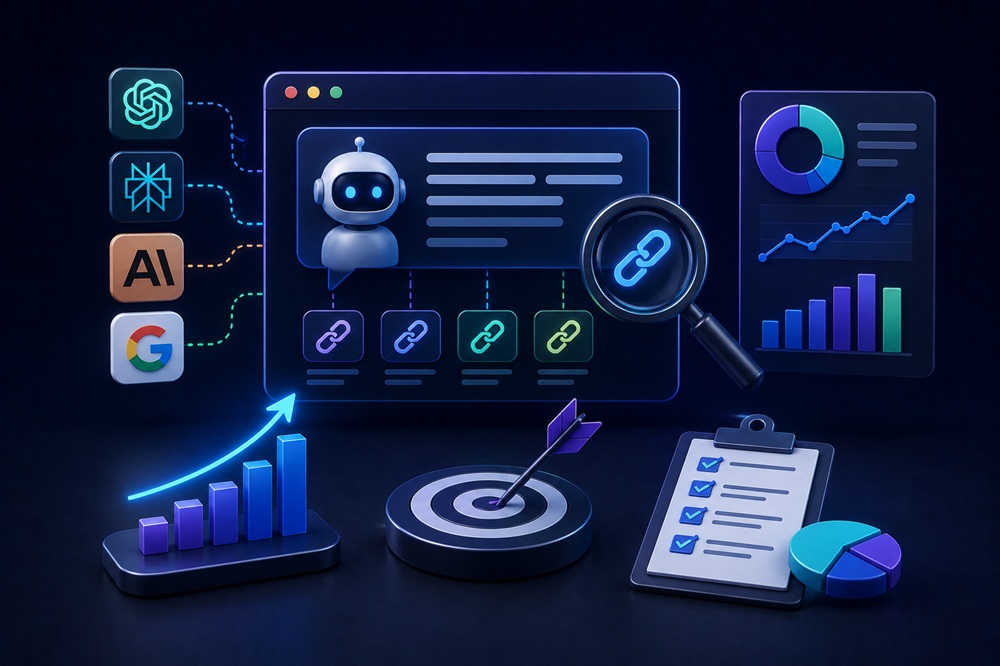
Traditional SEO measurement is mature — rankings, organic traffic, click-through rate, conversions. AEO measurement is younger and messier. There is no equivalent of Google Search Console for ChatGPT, Perplexity, or Claude (yet). But the discipline of measuring AI engine citations is critical for any AEO program, and a workable methodology exists in 2026.
What to actually track
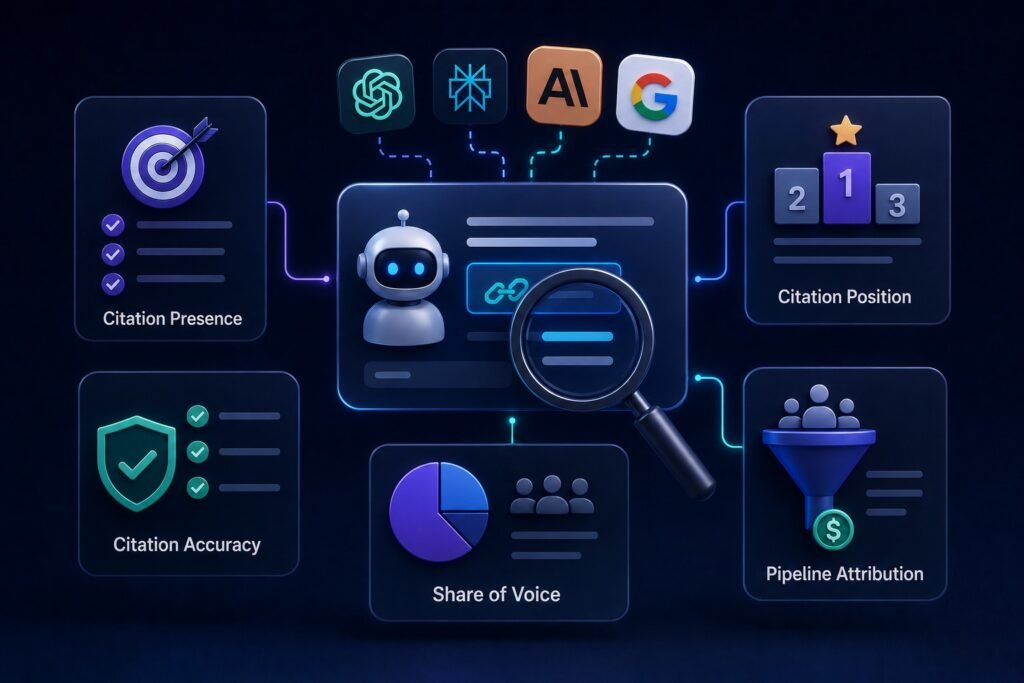
A complete AEO measurement program tracks five categories of signal:
Citation presence — for a defined set of target queries, does your business appear in the AI engine’s answer? Tracked across all four major engines (ChatGPT, Perplexity, Claude, Google AI Overviews) per query.
Citation position — when cited, where do you appear in the answer? First mention, secondary, or buried? Position affects how likely a reader is to act on the citation.
Citation accuracy — does the AI engine cite you accurately? Wrong attribution, misstated facts, or outdated information indicate schema or content problems even when citation share looks healthy.
Share of voice — across your target query set, what percentage of citations across all engines are you versus competitors? This is the AEO equivalent of organic ranking share.
Pipeline attribution — what share of inbound leads cite AI engines as their source, either directly (“found you on ChatGPT”) or indirectly (brand-search lift, referral patterns suggesting AI-driven discovery)?
The hard truth: no single tool measures all five. AEO measurement in 2026 requires a combination of manual query testing, dedicated AEO tracking tools, web analytics, and structured intake forms.
Common questions
How do you measure AI engine citations?
Measure AI visibility using a fixed set of buyer-focused prompts and record whether your website is
cited, mentioned, or absent from the resulting answers. Run the same prompts across the AI engines relevant to your audience, such as ChatGPT, Perplexity, Gemini, and Google AI Overviews. This creates a repeatable baseline that can be compared over time instead of relying on occasional manual searches.
What is an AI citation rate?
Citation rate is the percentage of tracked prompts or AI responses in which your website is cited as a source. A simple calculation is:
Citation rate = prompts with your domain cited ÷ total prompts tested × 100
Track this separately for each AI engine because citation behavior differs between platforms. It is also useful to track brand mentions separately: a brand can be mentioned without its website being cited.
What prompts should you track for AI citation monitoring?
Use prompts that reflect how your actual buyers ask questions rather than simply copying traditional SEO keywords. Include categories such as
informational, problem-aware, commercial, comparison, recommendation, and brand-specific prompts. A practical starting point is 10–25 high-value prompts, with larger businesses often expanding the set to 50 or more. The important thing is to keep the prompt set consistent enough to identify meaningful changes over time.
Which AI engines should businesses monitor?
At minimum, monitor the AI platforms that your target audience actually uses. For many B2B businesses, that means
ChatGPT, Google AI Overviews/AI Mode, Perplexity, and Gemini. Depending on the market, you may also monitor Claude, Copilot, or other AI search experiences. Avoid combining all platforms into one number because an increase on one engine can hide a decline on another.
Which tools can track AI citations?
Dedicated AI visibility platforms include tools such as
Profound, Peec AI, Otterly, Scrunch, Siftly, and similar platforms. Some established SEO platforms have also added AI visibility capabilities. The important features to compare are engine coverage, prompt tracking, citation-level URLs, competitor monitoring, historical reporting, and whether the platform distinguishes mentions from actual source citations.
Can you measure AI citations without buying a specialized tool?
Yes. Create a spreadsheet containing your target prompts and run them manually on the AI platforms you want to monitor. Record the date, engine, prompt, whether your brand was mentioned, whether your domain was cited, the cited URL, competitors cited, and any notable description of your brand. A small monthly prompt set can provide a useful baseline before investing in dedicated monitoring software.
What metrics should you track besides citation rate?
Track
brand mention rate, citation rate, share of AI voice, cited URLs, competitor citation share, citation position, sentiment or accuracy, and changes over time. It is particularly useful to identify which pages are repeatedly cited because that can reveal the content formats and topics that AI systems find useful. Research also suggests that citation count alone can miss whether a cited page actually contributes substantive information to the generated answer.
How should you report AI citation performance to stakeholders?
Create an AI visibility dashboard that shows
citation rate by engine, citation share against competitors, top-cited pages, prompt-level wins and losses, and month-over-month changes. Separate branded prompts from non-branded category prompts so strong existing brand awareness does not make visibility appear better than it is. Most importantly, connect citation changes to business outcomes such as AI referral traffic, branded searches, leads, and conversions where those can be measured. AI citation tracking should ultimately explain whether your content is becoming more visible and useful—not simply produce another vanity metric.
The biggest measurement mistake is over-indexing on raw “citation count” without context. Being cited once in ChatGPT for a low-volume query matters less than being cited consistently across all four engines for the queries your buyers actually ask. Build your measurement around your defined query set, not around vanity metrics.
The second mistake is impatience with measurement maturity. AEO measurement in 2026 is roughly where SEO measurement was in 2008 — workable but imperfect. Tooling will improve. The discipline of defining query sets, tracking citations monthly, and correlating to pipeline is what builds durable AEO competence even as the tools change underneath.
Iscope Digital’s
AI Engine Optimization service includes monthly citation tracking across all four major engines and quarterly competitive share-of-voice reporting as standard. For context on how long it takes to see those numbers move, see
How long does AI Engine Optimization take to show measurable results?