Not all content is equally citable. Two articles covering the same topic, with the same facts, can perform very differently in AI engine citations depending on how they’re structured. After auditing hundreds of pages for citation performance, clear patterns emerge: some formats get extracted and cited constantly, others get passed over no matter how good the underlying information is. This article ranks the formats.
The formats that get cited
AI engines extract answers most reliably from content that mirrors how a question gets asked and answered. Five formats consistently outperform.
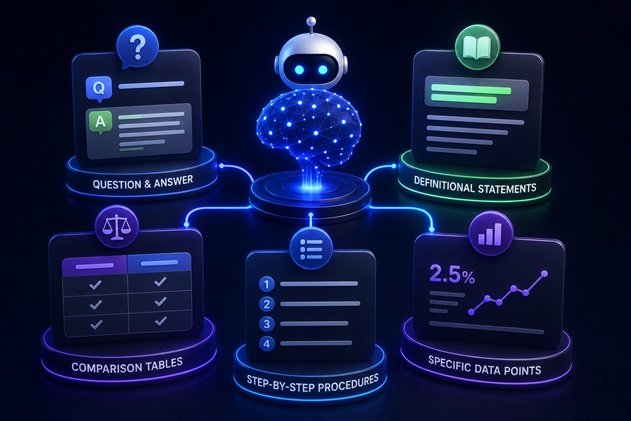
Question-and-answer structure is the single most citable format. A heading phrased as the literal question a buyer asks, followed by a definitive answer in the first sentence, gives the engine a clean extraction target. This is why FAQ sections and Q&A-structured articles punch above their weight.
Definitional statements — “X is a [category] that [does what] for [whom]” — get cited heavily for “what is” queries. A clear, single-sentence definition near the top of a page is one of the highest-value sentences you can write for AEO.
Comparison tables and structured comparisons get cited for “X vs Y” queries. When you lay out two options across consistent dimensions, AI engines extract the comparison directly into their answers.
Step-by-step procedures with clear sequential structure (especially marked up with HowTo schema) get cited for “how do I” queries. Numbered steps with concise instructions extract cleanly.
Specific data points with context — “B2B contact data decays at roughly 2.5% per month” — get cited when the number is attributed, bounded, and stated plainly. Vague claims (“data decays quickly”) don’t.
Common questions
Which content formats do AI search engines cite most often?
There is no single format that every AI engine prefers. Recent 2026 studies consistently show strong citation rates for
listicles, informational articles, comparison pages, how-to guides, and product or service pages, but the preferred format varies by engine and search intent. One large study of more than 1 million citations found listicles, articles, and product pages together accounted for 52% of citations.
Do AI engines prefer FAQ-style content?
FAQ-style content can perform well because it presents a specific question followed by a direct answer that is relatively easy for retrieval systems to identify and use. However, FAQ schema itself should not be confused with a citation advantage. The important part is the
clear question-and-answer structure and usefulness of the underlying content, not simply adding FAQ markup.
Are listicles good for AI citations?
Yes. Listicles are among the most frequently cited content formats in recent AI-search research. They work particularly well for queries involving recommendations, rankings, options, and comparisons because information is already divided into discrete, extractable points. A 2026 study found listicles represented 21.9% of citations across its dataset, while another large Google AI Overview dataset found listicles were the most common classified format.
Do comparison pages get cited by AI engines?
Comparison content can perform particularly well for commercial and evaluation queries such as “X vs. Y,” “best alternatives,” and “which is better.” Research has found especially strong performance for comparison content in ChatGPT, although the strength varies considerably by engine. The key is to provide substantive comparisons, clear criteria, specific differences, and useful conclusions rather than creating thin pages designed solely around two product names.
Are how-to guides useful for AI citations?
Yes. How-to content naturally breaks information into explicit steps, making it useful for queries where users want instructions or processes. Recent research identifies how-to guides as a frequently cited format, particularly for instructional queries. Clear headings, numbered steps, concise explanations, prerequisites, and specific outcomes can make the information easier for AI systems to retrieve and incorporate.
What content formats do AI engines tend to ignore?
AI engines do not universally “ignore” particular formats, but
thin, generic, poorly structured, or weakly differentiated content is less likely to provide useful citation material. Formats such as infographics, podcasts, opinion pieces, and generic promotional pages can be harder to cite when they do not expose their key information in accessible text. Recent Google AI Overview data showed very low citation shares for infographics, podcasts, comments, and some other formats.
Does content length determine whether AI engines cite a page?
Not by itself. Longer content can provide more evidence, context, comparisons, and factual material for an AI system to use, but simply making an article longer does not make it citation-worthy. Research examining citation “absorption” found that highly influential pages tend to be longer
and more structured, semantically aligned, and rich in extractable evidence such as definitions, numbers, comparisons, and procedures.
What content structure gives B2B pages the best chance of being cited?
For B2B content, a strong structure is usually:
Question → direct answer → supporting explanation → evidence/examples → practical takeaway.
Use descriptive H2/H3 headings, answer important questions early, keep paragraphs focused, use tables or lists when they clarify comparisons, and include specific facts rather than vague marketing language. Most importantly, create content that directly satisfies the search intent. Current research suggests there is
no universal AI-citation format; different engines and industries have distinct citation patterns.
Restructuring is usually higher-leverage than writing new content. Converting an existing article’s buried answers into question-shaped headings with front-loaded responses can improve its citation performance without adding a single new fact. The information was already there; it just wasn’t in a format engines could extract.
When you do create new content, write it answer-first from the start. The format conventions that win AI citations — clear definitions, question-shaped headings, front-loaded answers, structured comparisons — also happen to make content more useful to human readers. There’s no tradeoff. Citable content is good content.
Iscope Digital’s
AI Engine Optimization service includes content restructuring as a core workstream — auditing your existing pages and rebuilding them into citable formats. For the foundational explanation of how AEO works overall, see
What is AI Engine Optimization (AEO) and how does it differ from SEO? and for the signals behind citation decisions,
How do AI engines choose which sources to cite?