Consumer marketers have three primary direct channels — postal mail, email, and SMS — and each has distinct strengths, costs, regulations, and ideal uses. Choosing the right channel for each goal, and combining them effectively, determines whether your budget produces response or waste. This article compares the three across the dimensions that matter in 2026.
The three channels compared
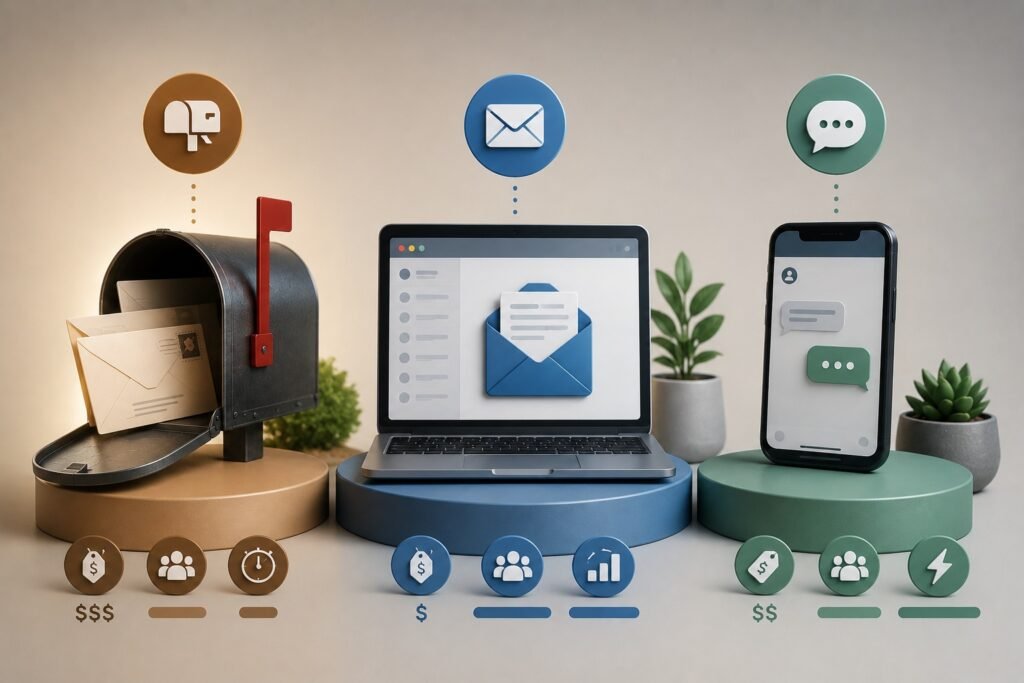
Each channel occupies a different position on cost, reach, immediacy, and regulation.
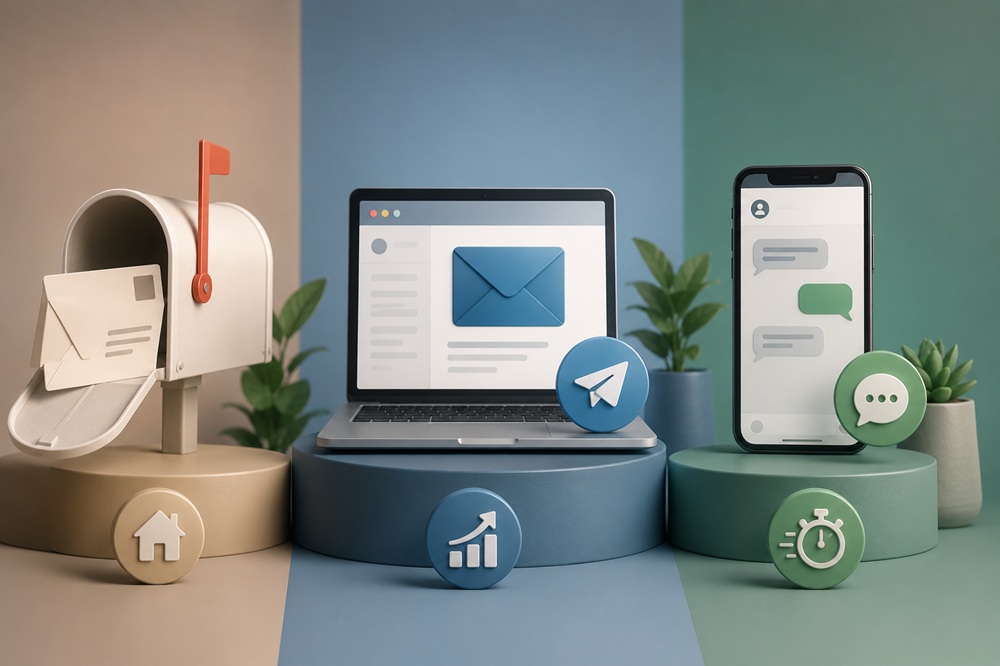
Direct mail (postal) is the most expensive per piece but the most tangible and least cluttered. Physical mail commands attention email can’t, has a longer shelf life (it sits on a counter), and reaches consumers regardless of email or phone status. It’s slow, costly, and harder to measure, but cuts through digital noise — especially valuable for high-value offers and audiences saturated with digital messages.
Email is the workhorse — cheap, scalable, measurable, and flexible. It supports rich content, automation, and detailed tracking, at a fraction of direct mail’s cost. Its challenges are inbox competition, deliverability management, and declining open-rate visibility. It’s the default channel for most consumer marketing because of its economics and versatility.
SMS is the most immediate and highest-engagement channel — texts are opened within minutes and read at rates email can’t match. But it’s intimate, easily intrusive, strictly regulated (TCPA requires prior express consent), and limited in content. It’s best reserved for time-sensitive, high-value, explicitly-consented communications where immediacy justifies the intrusion.
Common questions
What is the difference between direct mail, email, and SMS marketing?
Direct mail reaches consumers through physical mail, email uses electronic messages sent to an inbox, and SMS reaches consumers through text messaging. Each channel has a different strength:
direct mail is strong for attention and tangible offers, email is strong for scalable education and nurturing, and SMS is strong for timely, short-form communication. The best channel depends on the audience, offer, buying journey, and desired action.
Which channel is best for generating immediate responses?
SMS is often the strongest choice when the message is genuinely time-sensitive and the recipient has an appropriate relationship or permission to receive texts. Examples include appointment reminders, delivery updates, limited-time offers, or alerts. Email can also generate fast responses while providing more room for explanation. Direct mail generally has a longer response cycle, making it better suited to offers where physical presence and repeated exposure matter.
When is direct mail better than email?
Direct mail can be useful when you need to stand out in a crowded digital environment, reach an audience that is difficult to engage online, or make a high-value offer feel more tangible. Postcards, letters, catalogs, packages, and other physical formats can support brand awareness, promotions, customer retention, and higher-consideration purchases. It can also work particularly well when combined with a digital follow-up campaign.
When should you choose email marketing?
Email is generally the most flexible of the three for ongoing communication. It works well for newsletters, educational content, promotions, product announcements, onboarding, nurturing, retention, and abandoned-purchase follow-up. It also allows businesses to provide substantially more context than SMS while remaining faster and less expensive to distribute than physical mail.
When is SMS marketing the best option?
SMS is most appropriate when the information is short, timely, and genuinely useful to the recipient. It can work well for reminders, confirmations, alerts, appointment-related communications, limited-time promotions, and urgent updates. SMS should not simply be treated as “email with fewer words.” Consumers generally expect texting to be more immediate and less intrusive, so message frequency and permission are particularly important.
Which channel is cheapest: direct mail, email, or SMS?
Email is generally the least expensive to distribute at scale because there are no physical production or postage costs. SMS has relatively low distribution costs but can become expensive at high volumes, depending on the provider and market. Direct mail has additional costs for creative production, printing, fulfillment, and postage. The cheapest channel is not necessarily the most profitable, however. Compare
cost per qualified response or customer, not simply cost per message.
Should businesses combine direct mail, email, and SMS?
Yes, when the audience and campaign justify a coordinated approach. For example, a business might send direct mail to create awareness, follow with email containing more detailed information, and use SMS for a time-sensitive reminder where appropriate. Each channel should have a distinct role rather than repeating the same message three times. A coordinated campaign can also help businesses reach consumers through their preferred communication channel.
What should businesses consider before using email or SMS for marketing?
Compliance requirements vary by country, state, channel, and type of message. In the US, commercial email is subject to CAN-SPAM requirements, including accurate sender information and an opt-out mechanism, and the FTC explicitly notes that CAN-SPAM applies to B2B as well as consumer email. SMS can involve additional federal and state requirements, including rules governing communications to wireless numbers. Businesses should therefore verify the applicable requirements and maintain appropriate consent and suppression records before launching campaigns.
Respect the consent rules, especially for SMS. The TCPA’s prior-express-written-consent requirement for marketing texts is strict and the penalties are severe — never send marketing SMS without proper documented consent. Email’s opt-out framework is more forgiving but still requires honoring opt-outs. Direct mail is loosest but still subject to preferences. Knowing and following each channel’s rules is non-negotiable.
Consider coordinated multi-channel sequences for important campaigns. Reaching consumers through complementary channels — mail for attention, email for detail, SMS for urgency among consented contacts — outperforms single-channel campaigns when coordinated well. The investment in coordination pays off in reinforced messaging and higher overall response, provided each channel’s consent and frequency rules are respected.
Iscope Digital’s
B2C Email & Postal Data service provides both email and postal data for multi-channel consumer campaigns, and our
Email Marketing service handles deliverability-optimized email execution. For choosing the right data behind these channels, see
Demographic vs behavioral vs purchase-intent data and on the compliance behind each,
Is B2C email marketing still legal in the US?