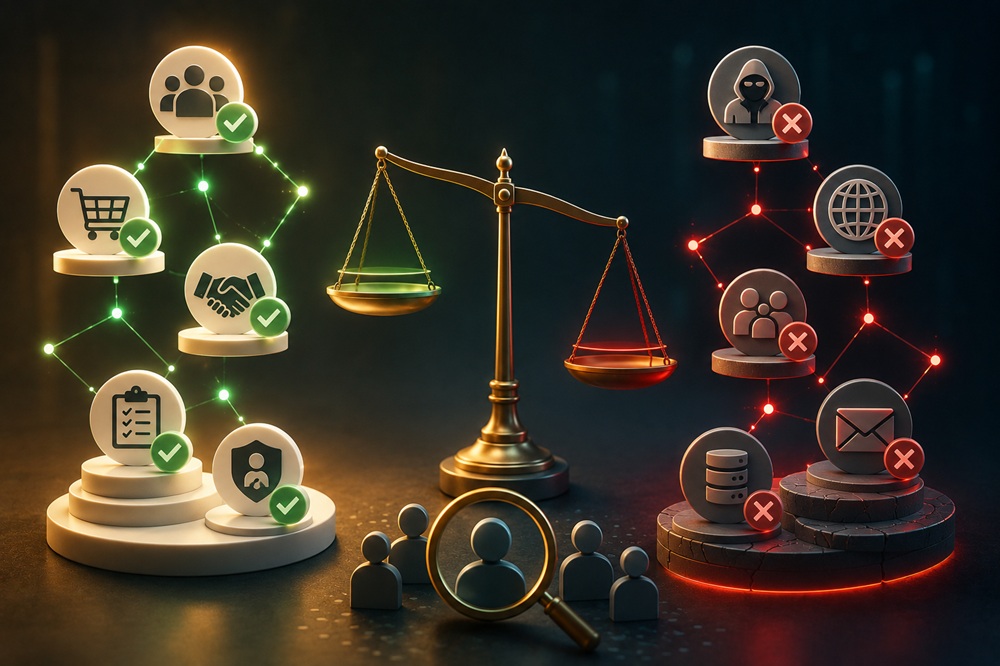
Consumer marketing data comes from a wide range of sources, and they are not created equal. Some produce clean, consented, deliverable data; others produce records that bounce, draw complaints, and create compliance exposure under state privacy laws. This article ranks the common B2C data sources from most to least trustworthy and explains how to tell them apart.
The sources, ranked
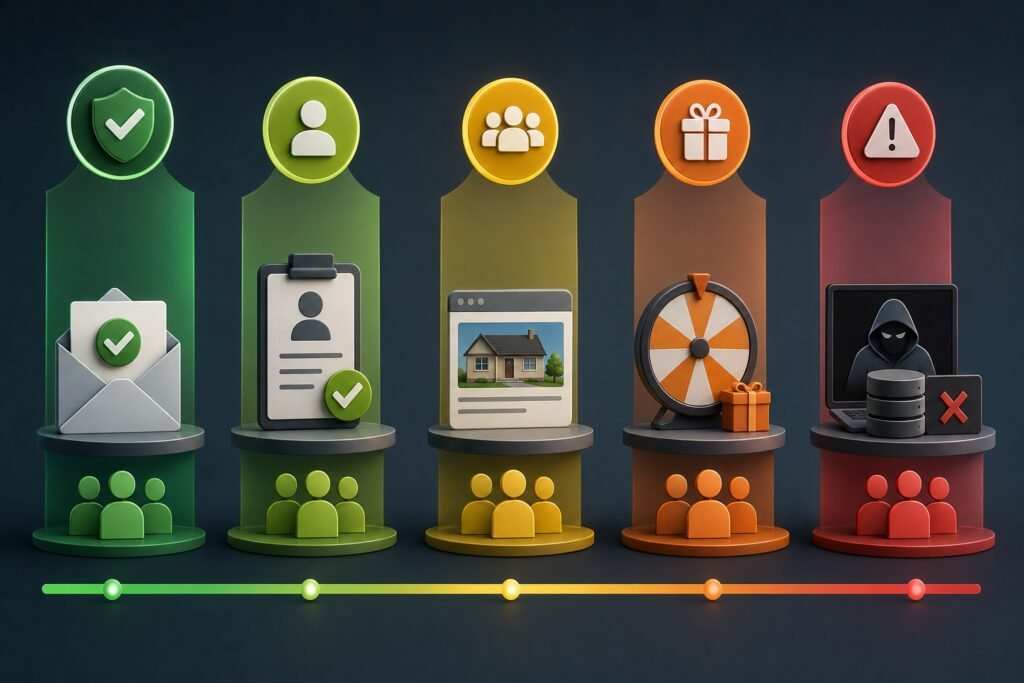
Consumer data sources fall along a spectrum of quality and trustworthiness.
Most trustworthy — direct, confirmed opt-in. Data where a consumer subscribed directly to a specific brand and confirmed via double opt-in. The consent is clear, the address is verified, and the provenance is documented. This is the gold standard, though it exists in smaller volumes.
Strong — first-party and direct registration. Consumers who registered, subscribed, or purchased directly from a known source — magazine subscriptions, account registrations, verified survey panels. Single opt-in but with clear, documented provenance.
Moderate — co-registration and compiled public data. Data from co-registration (consumers who agreed to share data with “partners”) and compiled public records (property records, public filings). Legal when handled properly, but consent is broader and vaguer, and quality varies.
Weak — sweepstakes and incentivized sign-ups. Consumers who entered contests or claimed offers, often without genuine interest in the brands they’re shared with. Technically opt-in, but engagement and deliverability are poor and complaint rates high.
Avoid — scraped, harvested, and recycled data. Email addresses harvested from websites without consent, lists recycled endlessly across buyers, and data of unknown origin. High bounce rates, spam traps, and serious compliance exposure.
Common questions
How should B2C data sources be ranked?
A practical hierarchy is:
- Zero-party data — information consumers intentionally provide
- First-party data — information collected directly through your own channels
- Verified second-party data — a partner’s first-party data with clear provenance
- Reputable third-party data — aggregated or enriched data with documented sources
- Data brokers with unclear provenance — higher-risk and harder to validate
- Scraped, harvested, or questionable lists — generally avoid
The further removed the data is from the consumer, the more important source transparency, accuracy, permitted use, and opt-out controls become.
Why is first-party B2C data usually the best source?
First-party data comes directly from interactions with your own customers or prospects, such as purchases, registrations, website activity, customer service interactions, and loyalty programs. Because the business observes the interaction directly, it can generally establish better context and accuracy than an outside aggregator can. First-party data is also increasingly important as privacy expectations and restrictions around third-party tracking continue to evolve.
What is zero-party data and why is it valuable?
Zero-party data is information a consumer
actively chooses to provide, such as product preferences, interests, communication preferences, or stated purchase intentions. It can be particularly valuable because the consumer is explicitly telling the business something about themselves rather than the marketer having to infer it from behavior. The key is to collect it transparently and use it for the purpose communicated to the consumer.
Is purchased third-party B2C data trustworthy?
It can be useful, but it requires substantially more due diligence. Third-party data may be aggregated from multiple sources, and the buyer may have limited visibility into how individual attributes were collected, inferred, matched, or updated. The FTC has highlighted longstanding concerns around data-broker transparency, including consumers’ ability to understand sources, correct information, and opt out.
Which B2C data sources should marketers avoid?
Be cautious with sources that cannot clearly explain
where the data came from, how recently it was collected, how identities were matched, what permissions or rights support its use, and how consumers can opt out. Scraped personal information, purchased lists with vague provenance, artificially inferred sensitive attributes, and vendors unwilling to document their sourcing should be treated as major red flags. The FTC has taken enforcement action involving consumer data practices where consent and sensitive-location-data controls were inadequate.
How can you tell whether a B2C data vendor is legitimate?
Ask the vendor to document its
data sources, collection methods, update frequency, matching methodology, accuracy testing, consent or permission framework, consumer-access and correction process, opt-out mechanism, and downstream-use restrictions. Also ask whether the vendor can identify which records came from which source categories. A vendor that cannot explain its data provenance should not automatically be trusted simply because it offers a large database.
Should marketers prioritize data accuracy or data volume?
Accuracy and relevance should generally come before database size. A database containing millions of records is not particularly valuable if large portions are outdated, incorrectly matched, duplicated, or irrelevant to your audience. Test a representative sample and measure
match accuracy, freshness, completeness, deliverability where applicable, and actual campaign performance before committing to a large purchase.
What is the safest B2C data strategy in 2026?
Build around
first-party and zero-party data, use carefully vetted partner data to expand reach, and treat third-party data as an enrichment or supplemental source rather than automatically making it the foundation of your customer database. Maintain clear preference and suppression records, document data provenance, and regularly review whether your vendors’ collection and use practices remain appropriate. This approach provides greater control over both data quality and consumer expectations.
Make opt-in provenance a hard requirement, not a nice-to-have. Under state privacy laws, you may need to demonstrate where consumer data came from and what consent attached to it. Data without documented provenance is data you can’t defend if challenged and can’t use to honor consumer rights requests. The documentation is part of what you’re buying; data without it is worth far less.
Never let price alone drive the decision. The cheapest consumer data is cheap because it’s scraped, recycled, or weakly consented — and the hidden costs (deliverability collapse, complaint-driven reputation damage, compliance exposure) far exceed the savings. Establish source quality first, then optimize price among sources that clear the trustworthiness bar.
Iscope Digital’s
B2C Email & Postal Data service sources from opt-in registration channels with documented provenance — never scraped or harvested. For the consent foundation behind good sources, see
What is opt-in consumer data and how do you verify it? and on the suppression that protects deliverability,
Suppression lists explained.