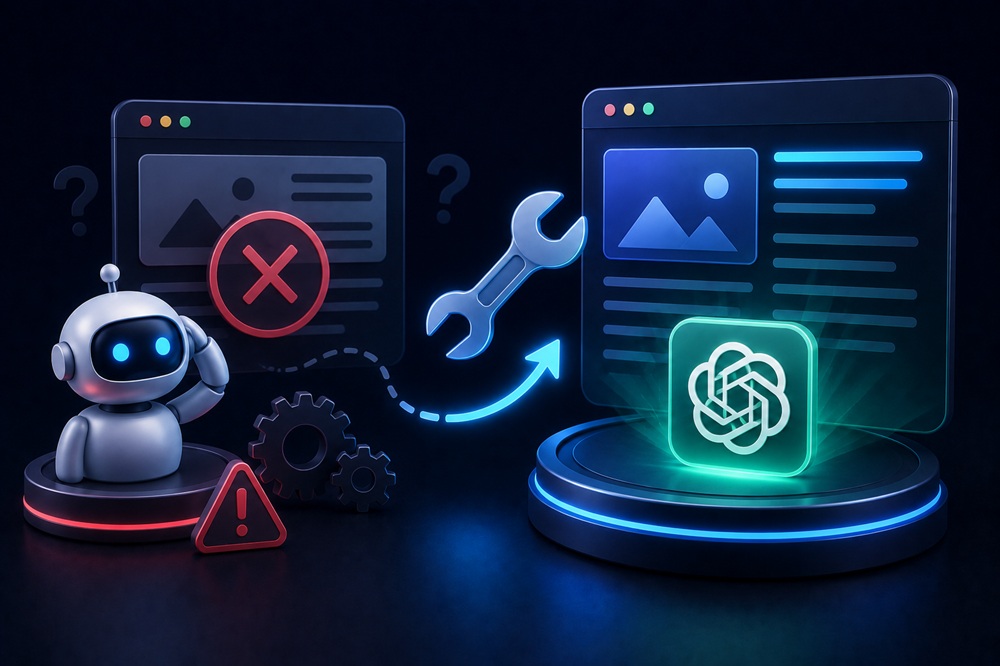
-If your B2B competitors are being cited in ChatGPT, Perplexity, and Claude answers while your business is invisible, the cause is almost always one of six specific problems — each of them fixable. This article walks through the diagnostic logic and the corresponding fixes, in the order you should address them.
The six most common causes
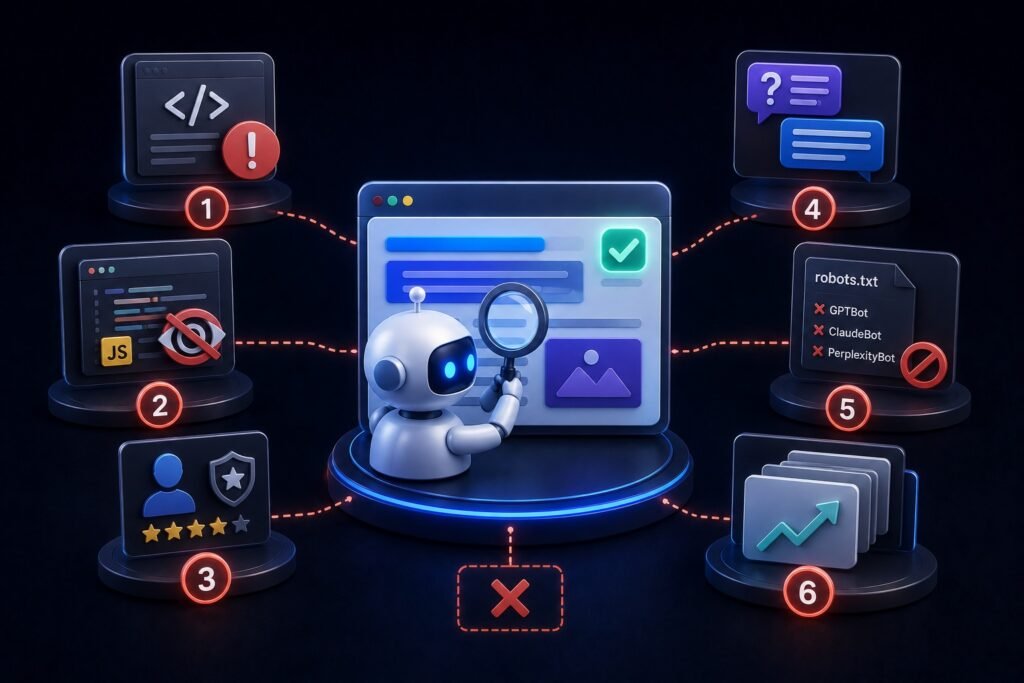
Out of every B2B site audited for AEO problems in 2025 and 2026, the absent-from-AI-citations symptom traces back to one or more of these six causes:
1. Missing or broken structured data. Your site lacks JSON-LD schema, or has schema that fails validation. AI engines can’t extract structured facts they can’t parse.
2. Content stored in JavaScript that crawlers can’t render. Single-page applications and heavily JS-dependent CMSes can leave AI crawlers seeing empty HTML. Your content effectively doesn’t exist to engines that don’t execute JavaScript at scale.
3. Weak E-E-A-T signals. No named authors, no organizational identity, no demonstrated expertise. AI engines have learned to penalize anonymous and identity-light content because it’s correlated with AI-generated spam.
4. Content format mismatch. Your content exists but doesn’t match the question-shaped format AI engines extract from. Prose that buries answers in long paragraphs gets cited less than question-headed structure with definitive answers.
5. Robots.txt or ai.txt blocking AI bots. Some sites have explicitly blocked GPTBot, ClaudeBot, or PerplexityBot — sometimes deliberately, sometimes accidentally through plugin defaults or hosting policies.
6. Insufficient topical depth. You have one article on your subject; competitors have twenty. AI engines reward sites with sustained, deep coverage of a topic — thin coverage gets de-prioritized in favor of the deeper source.
Common questions
Why might a B2B website not appear in ChatGPT answers?
There is no single ranking factor that guarantees inclusion in ChatGPT answers. A common technical reason is that the site or important pages cannot be crawled by
OAI-SearchBot. OpenAI says websites should allow OAI-SearchBot to crawl their content and ensure their hosting or CDN permits traffic from OpenAI’s published IP addresses.
How do you check whether ChatGPT can crawl your website?
Start with your
robots.txt file and confirm that OAI-SearchBot is not disallowed from important pages. Then check your CDN, WAF, firewall, bot protection, authentication, rate limits, and other infrastructure that could block automated crawlers. OpenAI specifically notes that security systems such as Cloudflare or other bot-mitigation layers can mistakenly block legitimate OpenAI crawlers.
Does being indexed by Google guarantee that ChatGPT will cite your site?
No. Google indexing and ChatGPT Search are separate systems. OpenAI states that ChatGPT Search ranking uses multiple factors intended to surface reliable and relevant information, and there is no way to guarantee top placement. A page can therefore rank in Google while not being selected as a source for a particular ChatGPT query.
Does blocking OAI-SearchBot prevent a website from appearing in ChatGPT?
It can prevent the crawler from using the site’s content for summaries and snippets. OpenAI recommends allowing OAI-SearchBot if you want your content to be discoverable, surfaced, and clearly cited in ChatGPT Search. If a page is disallowed, OpenAI notes that a URL may still sometimes be surfaced from other sources, but the page’s content may not be available for the same use.
Does a website need special AI schema or an AI sitemap to appear in ChatGPT?
No special schema or AI-specific file is required simply to appear in ChatGPT Search. OpenAI emphasizes crawler accessibility, while Google’s guidance similarly says there are no additional technical requirements or special schema needed for its AI search features. Standard SEO fundamentals—crawlability, indexable content, clear structure, useful content, and good page experience—remain important.
Can thin or generic B2B content prevent AI citations?
Yes, in practical terms. Even when a page is technically crawlable, AI systems still need a reason to select it as a useful source. Generic pages that repeat information available everywhere provide less distinctive material to cite. B2B content is more likely to be useful when it directly answers specific questions, provides original analysis or experience, includes concrete facts and examples, and clearly matches the user’s intent. Google likewise emphasizes helpful, reliable, people-first content for AI search visibility.
Does structured data help a B2B site appear in AI answers?
Structured data can help search systems understand entities and page content, but it is not a guaranteed mechanism for AI citations. The markup should accurately describe information visible on the page. Google’s guidance specifically recommends ensuring structured data matches visible content and says there is no special structured-data requirement for AI features.
What should a B2B company do if it wants more ChatGPT citations?
Start with the fundamentals:
allow OAI-SearchBot, remove accidental crawler blocks, make important pages publicly accessible, maintain strong technical SEO, and publish genuinely useful content that directly answers the questions your buyers ask. Then strengthen internal linking so important pages are easy to discover, keep content current, and build credible evidence and expertise into important articles. Google recommends the same basic principles for its AI search experiences, while OpenAI confirms that ChatGPT Search considers relevance and reliability rather than offering a guaranteed ranking formula.
Most B2B sites take 60 to 90 days to work through all six fixes systematically. Some can be parallelized (schema deployment and author markup can happen the same week), but the order of priority is fixed.
The biggest mistake is treating the visible symptom (“we’re not in ChatGPT answers”) as the problem instead of working back to causes. A typical wrong response is publishing more content — which doesn’t help if the underlying technical foundation is broken. A typical right response is auditing the foundation first.
Iscope Digital’s
AI Engine Optimization service begins every engagement with a six-cause diagnostic audit, identifies which problems your site has, and fixes them in priority order. To understand what an effective AI citation looks like once these problems are resolved, see
How do AI engines like ChatGPT and Perplexity choose which sources to cite?