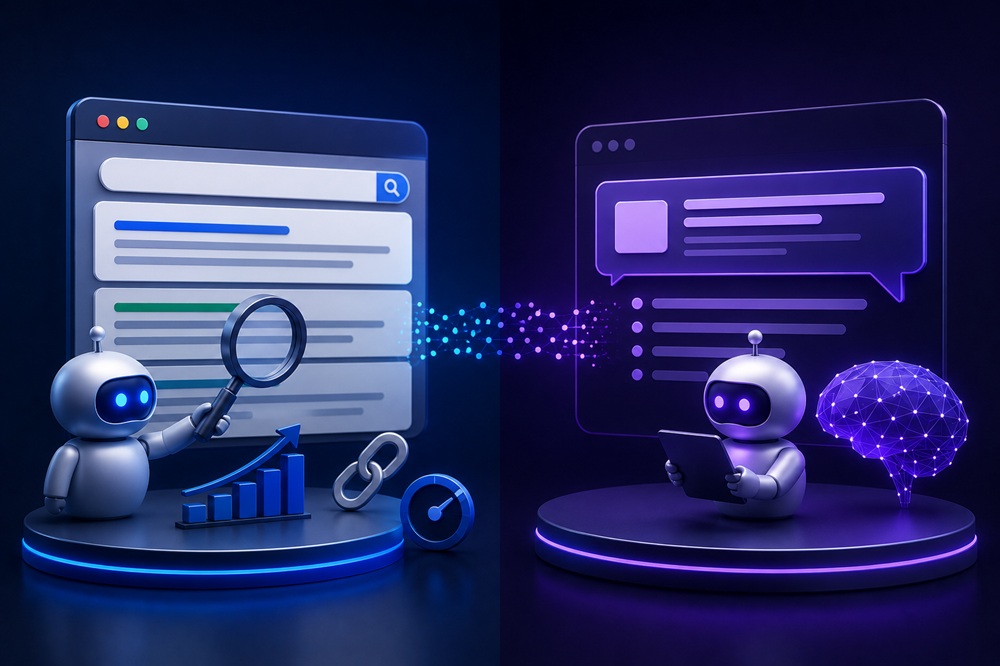
For two decades, B2B buyers researched vendors through Google. They typed a query, scanned blue links, clicked through to websites, and made decisions. That model is changing fast. By 2026, a meaningful share of B2B buyers begin research not in Google but inside AI engines – ChatGPT, Perplexity, Claude, and Google’s own AI Overviews – which return synthesized answers rather than ranked lists of links. AI Engine Optimization (AEO) is the discipline of being visible inside those answers.
What AEO actually is
AI Engine Optimization is the practice of structuring your content, technical foundation, and authority signals so that AI engines cite your business when answering buyer-research questions. Where SEO optimizes for a blue link on a search results page, AEO optimizes for inclusion inside the synthesized answer an AI engine produces.
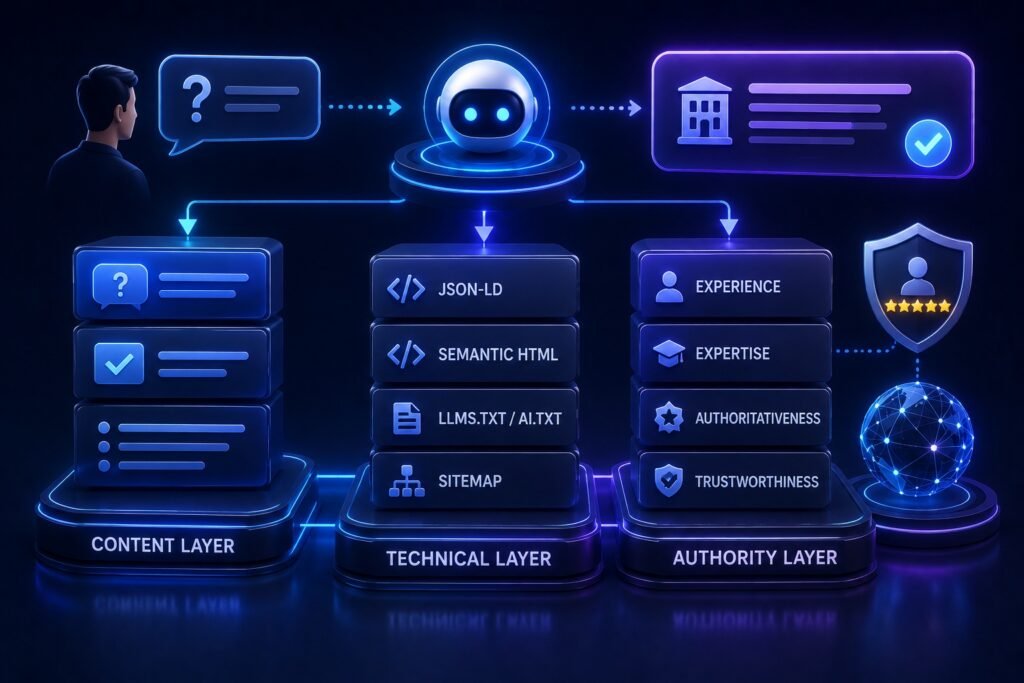
A complete AEO program works across three layers. The
content layer structures information as questions and definitive answers – the format AI engines extract most reliably. The
technical layer deploys JSON-LD schema (Organization, Service, Article, FAQPage), semantic HTML, llms.txt, ai.txt, and comprehensive sitemap markup. The
authority layer builds E-E-A-T signals (Experience, Expertise, Authoritativeness, Trustworthiness), claims author identity, and ensures consistent factual claims across the web.
The goal isn’t traffic in the traditional sense. It’s citation share – the percentage of relevant queries across AI engines where your business is named or linked in the answer. A B2B firm cited by ChatGPT when a buyer asks “best B2B marketing agencies in Florida” is winning a vendor-evaluation moment that may never produce a click but does produce a meeting.
Common questions
How is AEO different from SEO?
SEO optimizes for ranking – making a page appear high on Google’s results. AEO optimizes for citation – getting your business mentioned inside the answer an AI engine generates. SEO success means traffic to your site; AEO success means being named in the AI’s response, often with a citation link. The two disciplines share some foundations (clean schema, structured content, authority signals) but diverge on measurement, content format, and the specific technical files (llms.txt, ai.txt) that matter for AI engines.
Which AI engines does AEO cover?
The four primary engines in 2026 are ChatGPT (OpenAI), Perplexity, Claude (Anthropic), and Google AI Overviews. Microsoft Copilot, Meta AI, Apple Intelligence, and the agentic search products from each major lab also matter. A complete AEO program optimizes for all of them, since each engine has different citation patterns, content preferences, and weighting of authority signals.
Is AEO replacing SEO?
No, they coexist. SEO remains essential for the searches that still happen in Google, Bing, and other traditional search engines, particularly for buyers in late-stage research and direct comparison shopping. AEO addresses the growing share of early-stage buyer research that happens inside AI engines, where users rely on the synthesized answer instead of clicking through. B2B teams need both disciplines running in parallel.
How long does AEO take to show results?
First citations typically appear in 30 to 60 days after schema deployment, content restructuring, and llms.txt publication. Material citation share across all four engines usually develops over 90 to 180 days. AI engines re-index more frequently than Google, but authority signals take longer to build because they depend on consistent external evidence rather than on-page changes alone.
What does an AEO program actually do?
A complete program covers six workstreams: AI citation audit (where are you cited, where aren’t you), content restructuring (Q&A formats, definitional clarity), JSON-LD schema deployment, llms.txt and ai.txt publication, E-E-A-T markup (author identity, expertise signals), and monthly citation tracking across all four engines. The first three are setup work; the last three are ongoing.
Can I do AEO myself?
Parts of it, adding JSON-LD schema, publishing llms.txt, restructuring content into Q&A formats are well-documented and DIY-friendly for technical teams. The harder elements require infrastructure: monitoring citations across multiple AI engines, building authority signals that engines weigh heavily, and diagnosing why your business is cited for some queries but not others. Most B2B teams treat the technical foundation as in-house work and the ongoing optimization as outsourced.
What disqualifies a site from being cited by AI engines?
The most common disqualifiers are missing or broken structured data, content stored in JavaScript that crawlers cannot parse, low E-E-A-T signals (anonymous content, no author markup, no organizational identity), and factual inconsistencies between your site and other authoritative sources. AI engines prefer sources they can cite confidently; ambiguity is treated as risk.
How this applies to your business
If your buyers research vendors before reaching out, AI engines are now part of that research. By 2026, an estimated 40% of B2B buyers report using AI engines as their first research surface, before Google, before LinkedIn, before vendor websites. Being absent from AI citations means being absent from a meaningful share of vendor-evaluation processes.
What is AI Engine Optimization (AEO)?
AI Engine Optimization is the practice of creating and structuring website content so AI-powered search and answer systems can understand, retrieve, summarize, mention, or cite it. It focuses on making information clear, useful, authoritative, and easy for AI systems to extract when answering user questions. AEO is often discussed alongside terms such as Generative Engine Optimization (GEO), although terminology varies across the industry.
How is AEO different from traditional SEO?
Traditional SEO primarily focuses on improving visibility in search-engine results, while AEO focuses more heavily on visibility within AI-generated answers. SEO emphasizes areas such as crawling, indexing, rankings, search intent, links, technical performance, and organic traffic. AEO places additional emphasis on direct answers, structured information, entity clarity, evidence, and content that can be efficiently retrieved and used in an AI response.
Does AEO replace SEO?
No. AEO should generally complement SEO rather than replace it. AI systems still need to discover and retrieve information from websites, making technical accessibility, strong content, internal linking, and overall search visibility important. A strong SEO foundation can therefore support AEO, while answer-focused content can make existing SEO content more useful for AI-powered search experiences.
What types of content work well for AEO?
Content that directly answers specific questions can be particularly useful. Examples include
FAQs, definitions, how-to guides, comparisons, checklists, glossaries, original research, detailed product or service explanations, and expert analysis. The format itself does not guarantee visibility. The content needs to provide accurate, useful information that genuinely satisfies the underlying question.
How should you structure content for AEO?
Use descriptive headings that closely reflect the questions users ask, provide a direct answer near the beginning of each section, and then add supporting detail, examples, evidence, or context. Tables and lists can be useful when comparing options or presenting structured information. Avoid burying the answer beneath long introductions or excessive promotional copy.
Does structured data help with AEO?
Structured data can help search systems understand entities and relationships on a website, but it does not guarantee AI citations. B2B websites can use appropriate Schema.org types such as Organization, Article, Person, Service, Product, and BreadcrumbList where they accurately describe visible page content. Structured data should support clear content rather than be treated as an AEO shortcut.
Does AEO mean optimizing specifically for ChatGPT?
Not necessarily. AEO can refer broadly to optimization for AI-powered answer and search experiences, including ChatGPT, Perplexity, Gemini, Google AI features, and other systems. Each platform can use different retrieval and ranking processes, so there is no single optimization technique that guarantees visibility across all of them. The strongest strategy focuses on broadly useful, accessible, authoritative content.
How do you measure AEO performance?
Track whether your content is being
mentioned or cited in AI-generated answers for a consistent set of relevant prompts. Useful metrics include citation rate, brand mention rate, share of AI visibility, cited URLs, competitor citations, AI referral traffic, branded searches, and downstream conversions. Monitor individual AI engines separately because visibility can differ significantly between platforms.
How long does AEO take to produce results?
There is no fixed timeline. Technical improvements or updates to established authoritative pages can sometimes produce changes relatively quickly, while building broader topical authority and earning visibility for competitive subjects can take months. A consistent prompt-monitoring program over several weeks or months is more useful than judging AEO based on isolated AI searches.
What is the biggest mistake businesses make with AEO?
Treating AEO as a collection of tricks designed to manipulate AI-generated answers. Adding excessive FAQs, stuffing pages with questions, creating artificial author profiles, or adding unnecessary structured data does not substitute for useful content. The strongest AEO strategy is to
answer real customer questions clearly, demonstrate genuine expertise, provide evidence and original information, and make that content technically accessible to search and AI systems.
The practical first step is diagnostic. Open ChatGPT, Perplexity, Claude, and Google AI Overviews. Search for your category (“best B2B email marketing agencies”), your competitors, and your own brand name. Whatever you see is what your buyers are seeing. If your business isn’t cited where it should be, AEO is the discipline that changes that.
Iscope Digital’s
AI Engine Optimization service covers the full six-workstream program; citation audit, content, schema, llms.txt, authority, and monthly tracking. To see exactly where you stand today, you can also start with a free citation audit across all four engines. For a deeper look at the technical foundation, see our companion article on
JSON-LD schema for AI engines.