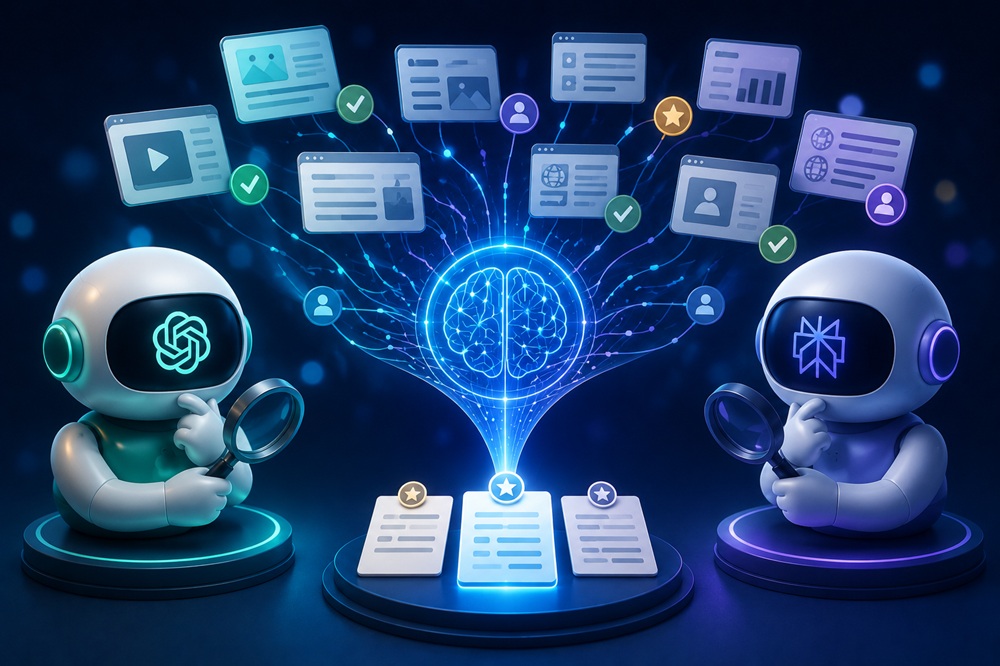
When ChatGPT, Perplexity, or Claude answers a buyer’s question with a citation to a specific business, the choice isn’t random. Each engine weighs a combination of signals — some shared, some unique — to decide which sources are reliable enough to cite. Understanding those signals is the foundation of any AI Engine Optimization program.
The six signals AI engines weigh
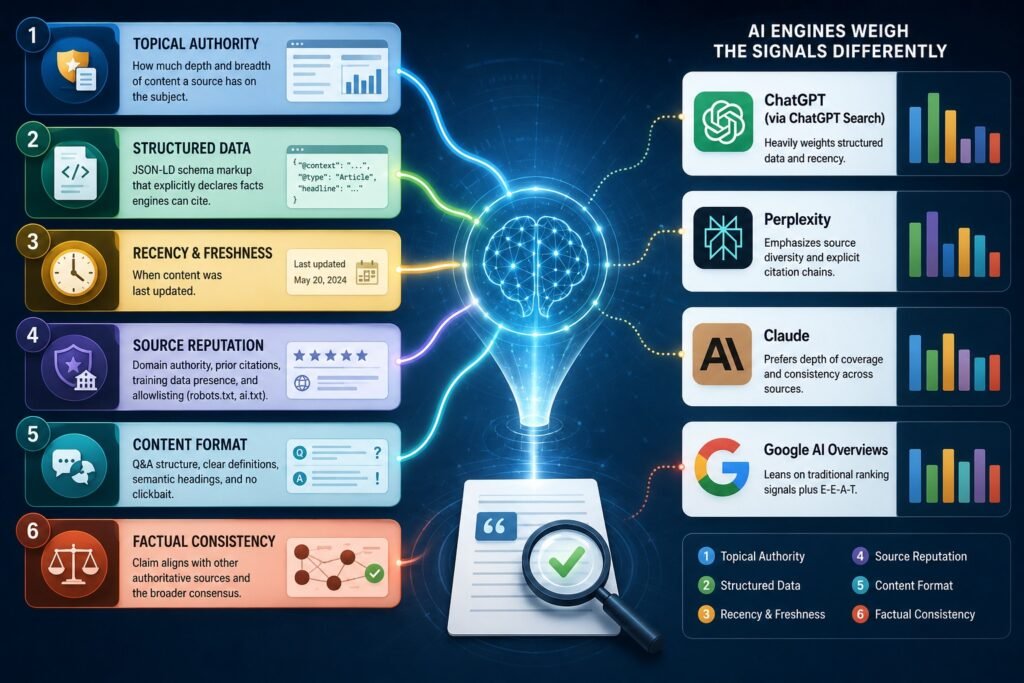
Across the four major AI engines (ChatGPT, Perplexity, Claude, Google AI Overviews), six categories of signals consistently determine citation:
Topical authority — how much depth and breadth of content a source has on the subject in question. A site with 30 articles on B2B email deliverability outranks one with three for queries in that space, all else equal.
Structured data — JSON-LD schema markup that explicitly declares facts the engine can cite with confidence. Organization, Article, FAQPage, HowTo, and Service schema are the most commonly extracted types.
Recency and freshness — when content was last updated. Stale content gets cited less, especially for queries about current best practices, pricing, or recent events.
Source reputation — domain authority, prior citations by trusted publications, presence in training data, and explicit allowlisting via robots.txt and ai.txt.
Content format — Q&A structure, clear definitional statements, semantic HTML headings, and absence of clickbait phrasing. AI engines extract definitive answers more reliably from question-shaped content.
Factual consistency — whether your claim matches what other authoritative sources say. An AI engine choosing between two sources will favor the one whose facts align with the consensus.
Different engines weight these differently. ChatGPT (via ChatGPT Search) heavily weights structured data and recency. Perplexity emphasizes source diversity and explicit citation chains. Claude prefers depth of coverage and consistency across sources. Google AI Overviews leans on traditional ranking signals plus E-E-A-T.
Common questions
Why was my site cited for one query but not another?
Citation is query-specific. An AI engine may cite your site for “what is database marketing” but skip it for “how does email append work” because the second query has stronger competing sources or your coverage of email append is shallower. Improving citation across a topical cluster requires building depth across all the related questions in that cluster, not just the central one.
Do AI engines look at backlinks the same way Google does?
Partially. Backlinks contribute to source reputation, but AI engines also weight factors Google doesn’t — like presence in their training data, explicit inclusion in publisher partnerships (especially for ChatGPT and Perplexity), and whether your schema markup matches the format their citation systems expect. A site with weak backlinks but strong schema and clear authority signals can outperform a backlink-rich site with poor structure.
Does posting frequency affect AI engine citations?
Yes, but not the way it affects SEO. AI engines reward freshness on time-sensitive topics (industry news, pricing, regulations) and depth on evergreen topics. A site that publishes one well-structured definitional article per week on its core subject builds AEO authority faster than a site that publishes daily on scattered topics.
How important is the author byline?
Critical. Author identity is one of the strongest E-E-A-T signals AI engines weigh. An article with a named author, an author bio page, a documented LinkedIn profile, and consistent authorship across multiple pieces in the same topic cluster will be cited more often than equivalent content without author attribution. Anonymous or “team-written” content suffers a citation penalty across all four major engines.
Do AI engines actually read llms.txt?
The major engines have publicly indicated they look for and process llms.txt files, though weighting varies. The file’s primary value is signaling to the engine that you’ve thought about AI-readable structure — it’s an authority signal as much as a content directive. Sites with valid llms.txt are also more likely to have other AEO foundations in place, which engines pick up on.
Does the engine prefer original content or aggregator pages?
Original content nearly always wins. AI engines explicitly de-prioritize aggregator and listicle pages that summarize other sources without adding original analysis. A primary-source article from a subject-matter expert outperforms an aggregator’s roundup of the same topic, even if the aggregator has higher domain authority.
What disqualifies a source from being cited?
Common disqualifiers include: missing or broken structured data, content stored in JavaScript that crawlers cannot parse without rendering, low E-E-A-T (anonymous content, no author markup, no organizational identity), factual inconsistencies with other authoritative sources, and blocking AI crawlers via robots.txt. Some engines also de-rank sites that publish AI-generated content without human editorial oversight.
How this applies to your business
If you’re trying to win citations from ChatGPT, Perplexity, Claude, and Google AI Overviews, you’re not optimizing for one algorithm — you’re meeting the bar set by four overlapping but distinct evaluation systems. The good news is that the signals overlap substantially. A site that has authoritative, well-structured, freshly maintained, deeply topical content with clear author attribution will be cited across all four engines, even if the citation share differs.
How do AI engines choose which sources to cite?
AI engines generally select sources based on a combination of
relevance, information quality, authority, freshness, accessibility, and how well the source answers the user’s specific question. There is no single public scoring formula that determines which website gets cited. Different AI systems can also produce different citations for the same query.
Does ranking highly in Google guarantee an AI citation?
No. A high Google ranking does not guarantee that ChatGPT, Perplexity, or another AI engine will cite the same page. AI systems use their own retrieval and ranking processes, although traditional SEO factors can still contribute to discoverability and authority. A page needs to be relevant and useful for the specific AI-generated answer, not simply rank well for a related keyword.
Does domain authority determine whether an AI engine cites a source?
Authority can matter, but it is not the only consideration. AI systems may cite established publications, specialist websites, company websites, government sources, research papers, and other sources depending on the question. A highly authoritative domain can still be a poor citation if its page does not directly answer the query. Likewise, a specialized source can be valuable when it provides particularly relevant or original information.
How important is content relevance for AI citations?
Relevance is critical. AI systems need sources that support the specific claim or answer being generated. A page that broadly discusses “B2B marketing” may be less useful for a question about a particular data-buying practice than a page that directly explains that subject. Clear headings, focused sections, concise definitions, and specific answers can make relevant information easier for retrieval systems to identify.
Does original information increase the chance of being cited?
It can. Original research, first-hand experience, proprietary data, expert analysis, detailed case studies, benchmarks, and unique examples give AI systems information that may not be easily available elsewhere. If dozens of websites repeat the same generic explanation, a source containing genuinely distinctive information can provide greater value to an answer.
Do AI engines prefer recent content?
Freshness can matter when the topic changes frequently. Information about software, regulations, pricing, companies, technology, and current events can become outdated quickly, making recent sources more useful. For relatively stable subjects, an older authoritative source can remain valuable. Updating important pages with accurate current information can therefore be more useful than publishing new content solely to create a newer publication date.
Does content structure affect AI citations?
Yes, clear structure can make information easier to retrieve and interpret. Useful structures include descriptive headings, concise answers, numbered procedures, comparison tables, definitions, examples, and clearly stated facts. For B2B content, a practical pattern is
question → direct answer → explanation → evidence or example. Structure alone does not guarantee citation, but it can make relevant information easier to identify.
Do backlinks still matter for AI citations?
Links can contribute to the broader authority and discoverability of a website, but AI citation systems should not be assumed to use backlinks in exactly the same way as traditional search engines. Strong references and links from credible sources can help establish reputation and discoverability. However, earning links should not replace creating content that directly answers important questions and provides useful, distinctive information.
Can AI engines cite company websites directly?
Yes. A company can be cited when its website provides relevant, trustworthy information, particularly for queries about its own products, services, documentation, policies, research, or expertise. For non-branded questions, however, the company needs to provide genuinely useful information rather than turning every page into promotional copy. Clear factual explanations and original expertise can make first-party content more useful as a source.
What makes a B2B page more likely to be cited by AI engines?
Focus on five things:
direct relevance, useful information, credible evidence, clear structure, and accessible content. Answer the question explicitly, support important claims, demonstrate genuine expertise, keep information current, and make the page easy for search and AI crawlers to access. Avoid thin pages that simply rephrase information available everywhere.
Can you guarantee that ChatGPT or Perplexity will cite your website?
No. There is no reliable method that guarantees citation by ChatGPT, Perplexity, or another AI engine. Their retrieval systems can change, results can vary by query and context, and competing sources may be selected instead. The practical goal is to increase the probability of being discovered and cited by consistently publishing useful, authoritative information and monitoring citation visibility over time.
The practical implication: invest in topical depth (cluster of related articles around your core service offerings), structured data (JSON-LD schema across every meaningful page), author identity (named bylines with consistent expertise signals), and freshness (regular updates to time-sensitive content). These investments pay dividends across all engines simultaneously.
Iscope Digital’s
AI Engine Optimization service diagnoses which of these signals your site is missing and rebuilds the foundation systematically. For the related question of how to define the category for your own team, see
What is AI Engine Optimization (AEO) and how does it differ from SEO?