A file called llms.txt started appearing on websites in late 2024, proposed as a standard for telling AI engines how to read and understand your content. Two years later, llms.txt has become one of the most asked-about AEO topics — and one of the most misunderstood. This article explains what llms.txt is, what it does, and whether your B2B site needs one.
What llms.txt is, exactly
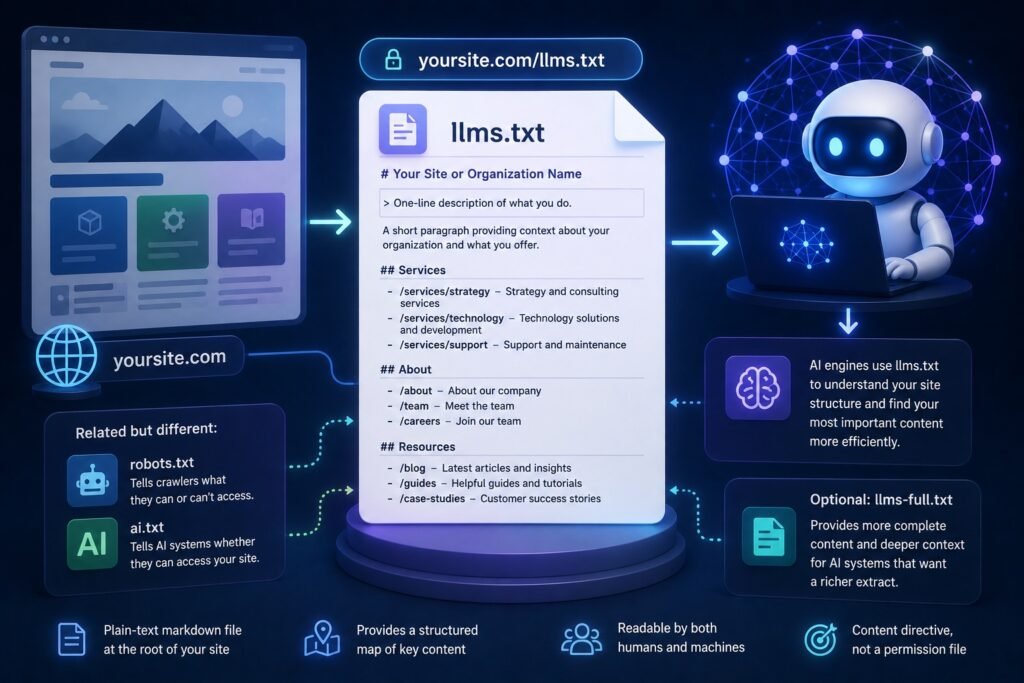
llms.txt is a plain-text markdown file placed at the root of your website (at
yoursite.com/llms.txt) that gives AI engines a structured map of your site’s most important content. It was proposed in 2024 by Jeremy Howard of Answer.AI as a complement to robots.txt and sitemap.xml — but designed specifically for large language models rather than traditional crawlers.
A typical llms.txt contains: an H1 with your site or organization name, a blockquote with a one-line description, a paragraph of context, and one or more sections (typically
## Services,
## About,
## Resources) listing your key pages with brief descriptions. The format is intentionally readable by both humans and machines.
The proposed standard also defines an optional
llms-full.txt that contains more complete content — useful for sites that want to feed AI engines a richer extract beyond just the URL index.
Important distinction: llms.txt is
not a permission file. It doesn’t tell AI engines whether they can crawl your site — that’s the role of robots.txt and ai.txt. llms.txt is a content directive: “here’s what’s on this site and how it’s organized.”
Common questions
What is llms.txt?
llms.txt is a proposed website file intended to provide AI systems with a curated, human-readable overview of a website’s important content. It is typically placed at the site’s root, such as
/llms.txt, and can contain links to key pages along with short descriptions. The idea is to make important information easier for AI systems to discover and understand.
Is llms.txt an official requirement for AI search in 2026?
No.
llms.txt is not a universal requirement for appearing in AI search results or being cited by AI systems. It is a proposal rather than a broadly established web standard. Businesses should not assume that creating the file will automatically increase visibility in ChatGPT, Google AI features, or other AI engines.
Does ChatGPT require llms.txt?
No. A B2B website does not need an
llms.txt file simply to be discoverable or cited in ChatGPT. For ChatGPT Search, making relevant content accessible to
OAI-SearchBot is a much more fundamental consideration. Businesses should focus first on crawlability, accessibility, content quality, and standard technical SEO.
Does Google use llms.txt for AI Overviews?
There is no requirement to create
llms.txt for Google AI Overviews or Google’s AI search features. Google’s guidance focuses on making content crawlable, indexable, useful, and technically accessible using established SEO practices. Adding an
llms.txt file should therefore be considered optional rather than a core Google optimization requirement.
Can llms.txt improve AI citations?
There is no reliable guarantee that it will. The concept is intended to help AI systems discover a curated set of important pages, but AI systems differ in how they crawl, retrieve, rank, and use web content. A well-structured
llms.txt could potentially provide useful navigation information for systems that choose to use it, but businesses should not expect it to directly increase citation rates.
Should B2B companies create an llms.txt file anyway?
It can be a reasonable low-cost experiment, particularly for large documentation sites, SaaS companies, publishers, and websites with extensive technical resources. A curated file can provide another organized way of presenting important resources. However, it should be treated as an
optional layer, not a replacement for XML sitemaps, robots.txt, internal linking, structured data, or strong content architecture.
What should a B2B llms.txt file contain?
If you choose to create one, keep it concise and useful. It can identify important resources such as:
- Company or product overview
- Core service pages
- Product documentation
- Pricing information
- Technical documentation
- Research and original studies
- Important guides
- Policies or other authoritative resources
The links should lead to useful, accessible pages and the descriptions should accurately explain what each resource contains.
What is the difference between llms.txt and robots.txt?
They serve different purposes.
robots.txt provides crawler instructions, including which crawlers or areas of a site should or should not be accessed.
llms.txt is intended as a curated content guide for AI systems. A website should not use
llms.txt as a substitute for properly configuring
robots.txt or managing access for specific AI crawlers.
What should you prioritize before creating llms.txt?
For a B2B website, prioritize
crawlability, indexability, strong technical SEO, clear site architecture, internal linking, high-quality content, accurate authorship, structured data where appropriate, and direct answers to important customer questions. Make sure AI crawlers and search engines can actually access the pages you want discovered. Once those fundamentals are in place,
llms.txt can be tested as an optional additional layer rather than treated as an essential AI SEO requirement.
If you’re not yet running an AEO program at all, llms.txt is not the place to start. Foundational JSON-LD schema, content restructuring around question-shaped queries, and author markup matter far more in early AEO work. llms.txt is the polish on a well-built foundation, not the foundation itself.
The practical recommendation: deploy llms.txt as part of a complete AEO foundation in the first 90 days of any AEO program. Treat it as table stakes for sites serious about being cited — even if its individual contribution to citation share is modest, its presence signals that the rest of your AEO work is likely competent too.
Iscope Digital deploys llms.txt as part of every
AI Engine Optimization engagement, along with the JSON-LD schema, ai.txt, and content restructuring that make the file useful in practice. For the related question of which schema types matter most for AI engines, see
JSON-LD schema for AI engines: which types matter most for B2B?