Every B2B database is decaying right now, as you read this. Contacts change jobs, companies restructure, titles shift, and email addresses go dead — quietly degrading the data you depend on. Understanding exactly how fast this happens, and why, is the foundation of any serious data-maintenance strategy. This article lays out the real decay numbers and what they mean for your database.
The decay rate, quantified
B2B contact data decays at approximately
2.5% per month, which compounds to roughly
30% per year. This widely cited industry benchmark means that of a freshly accurate database, about one record in forty goes stale every month, and nearly a third is inaccurate within twelve months.
Translated into concrete terms: a clean database of 10,000 B2B contacts loses accuracy on roughly 250 records each month. After six months, about 15% — some 1,500 records — is wrong. After a year, close to 3,000 records are inaccurate. After two years, nearly half the database may be unreliable.
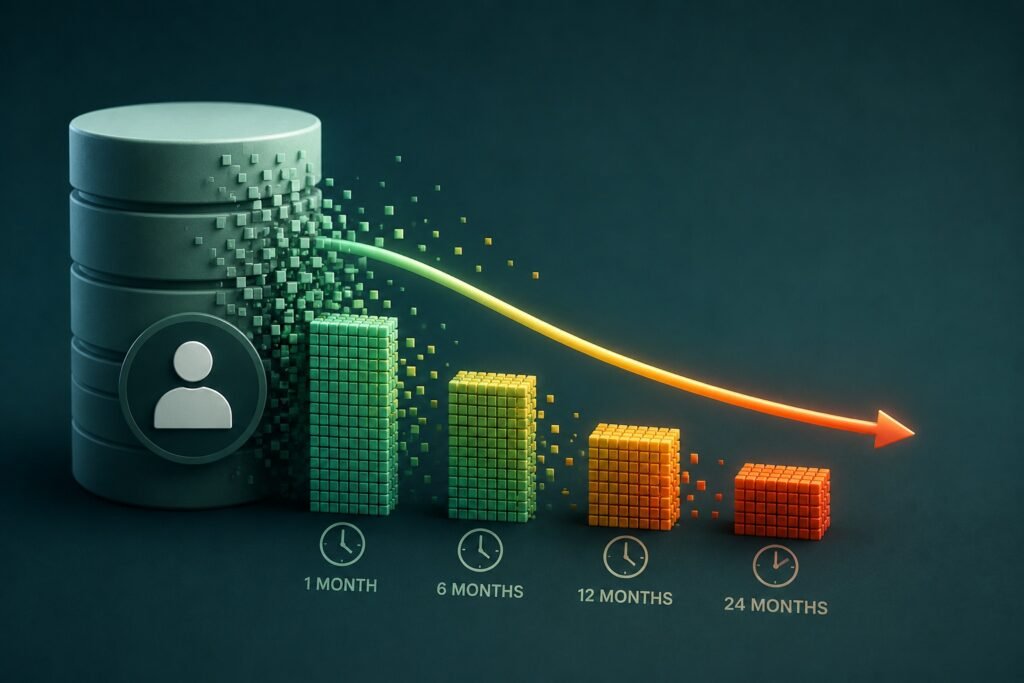
The decay isn’t uniform across fields. Some degrade faster than others:
Job titles and roles change frequently as people are promoted or shift responsibilities.
Email addresses die when people leave companies.
Direct phone numbers change with roles and locations.
Company information (name, industry codes) is relatively stable but shifts with mergers, rebrands, and relocations.
The person-to-company link — whether someone still works where your record says — is the most volatile and most consequential, because when it breaks, the entire record is effectively wrong.
The 2.5% monthly figure is a useful planning average, but actual decay varies by industry (high-turnover sectors decay faster), seniority (some roles turn over more), and economic conditions (layoffs and hiring waves accelerate decay).
Common questions
How fast does B2B contact data decay?
A practical 2026 benchmark is roughly 22–30% per year for general B2B contact data, although the rate varies significantly by industry, geography, seniority, and field. That means a database of 10,000 contacts could have roughly 2,200–3,000 records become materially outdated over a year without maintenance.
How much B2B data becomes inaccurate after one year?
Using the 22–30% benchmark, approximately one-quarter of a typical database may become stale within 12 months. Some 2026 studies report substantially higher rates when “decay” means that any tracked field has changed rather than the contact becoming completely unusable.
Which B2B contact fields decay fastest?
Job title and company affiliation tend to change faster than relatively stable identity information. One 2026 benchmark estimates job-title changes at around 20% annually and business-email invalidation at roughly 15–20%, while direct phone numbers show lower decay.
Does email data decay at the same rate as the entire contact record?
No. Email validity is only one component of data decay. A contact can have a deliverable email but still have an outdated job title, employer, department, or other important field. A 2026 analysis from ZeroBounce cited by industry research found roughly 23% annual degradation for email lists specifically, which should not be confused with the decay rate of an entire contact record.
Which B2B contacts decay fastest?
Senior and highly mobile professionals can decay faster than the average database. One 2026 dataset reports particularly high movement among senior contacts, while another reports that sales professionals were the most mobile function in its January–June 2026 observations.
Does industry affect B2B data decay?
Yes. Technology and startup-related contacts can decay considerably faster because of job mobility, layoffs, company closures, and restructuring. One 2026 benchmark estimates 28–38% annual decay for technology and SaaS, compared with lower rates for more stable sectors.
How often should B2B contact data be refreshed?
There is no single correct schedule for every field. For active prospecting, a quarterly refresh or verification cycle is a reasonable planning baseline, while high-value or fast-changing records may justify more frequent verification. Less frequently used CRM records can be refreshed on a longer cycle. The important principle is to refresh data according to its rate of change rather than treating the entire database as equally stable.
How can businesses calculate their own B2B data decay rate?
Take a representative sample of your CRM or prospect database and re-verify the records after a defined period. Measure changes separately for company, job title, email, phone, location, and other critical fields. For example, if 100 of 1,000 records have become invalid or materially incorrect after six months, your observed six-month decay is 10%. Repeating the measurement gives you a much more useful benchmark than relying on an industry-wide average.
Is the 30% annual B2B data decay figure still realistic in 2026?
Yes, as a planning benchmark, but it should not be treated as a universal constant. Recent 2026 research generally clusters around the 22–30% range for broad B2B data, while some studies measuring any field-level change report rates above 50%. The discrepancy largely comes from different definitions of “decay” and different methodologies.
What is the biggest mistake businesses make with B2B data decay?
Treating a database as a static asset. A contact record that was accurate when it was purchased or verified can become wrong without anyone doing anything incorrectly. The better approach is to treat data as perishable: verify important fields near the point of use, continuously capture changes, and maintain a defined refresh process rather than waiting for an annual cleanup.
How this applies to your business
Plan for decay as a constant, not an occasional problem. At roughly 2.5% per month, your database is degrading every single month whether or not you’re paying attention — so maintenance must be ongoing and budgeted, not a reactive scramble when campaigns start failing. Building refresh and hygiene into your data operations from the start prevents the slow rot that otherwise accumulates until it’s a crisis.
Monitor your bounce rate as your decay dashboard. It’s the most accessible real-world signal of how fast your specific database is degrading — a rising hard-bounce rate is decay made visible. Watching it lets you calibrate your refresh cadence to your actual decay rate rather than relying on the 2.5% average, which may understate or overstate your real situation depending on your audience.
Recognize that decay’s true cost extends beyond the dead records. The reputation damage from sending to decayed addresses undermines deliverability to your good contacts too, so the cost of unmaintained data is larger than the wasted records suggest. This makes maintenance one of the highest-return investments in a data program — it protects the value of every record, not just the decayed ones.
Iscope Digital’s
Database Marketing Solutions counteract decay through append, enrichment, and hygiene on the data you own, while the
Bizline Direct database is refreshed weekly to stay ahead of decay at the source. For how often to run maintenance, see
CRM hygiene: how often should you clean your database? and on refresh cadence specifically,
How often should B2B databases be refreshed?